



Double klondike solitaire rules
The card game klondike solitaire is the world’s most popular single-player card game. Do you enjoy playing klondike solitaire and want to try something new? Then give double klondike solitaire a go! This version uses two decks of cards instead of one. On this page, you’ll find the complete rules of double klondike solitaire.

General rules of double klondike solitaire
The rules of double klondike solitaire are very similar to those of classic klondike solitaire.
- Double klondike solitaire is also a single-player card game.
- You use two standard decks of 52 playing cards, without Jokers. You play with a total of 104 cards.
- The card order is Ace, 2, 3, 4, 5, 6, 7, 8, 9, 10, Jack, Queen, King.
- The goal of the game is to move all cards to the foundation piles.
Setup
Here’s how to set up double klondike solitaire:
- Shuffle the cards thoroughly.
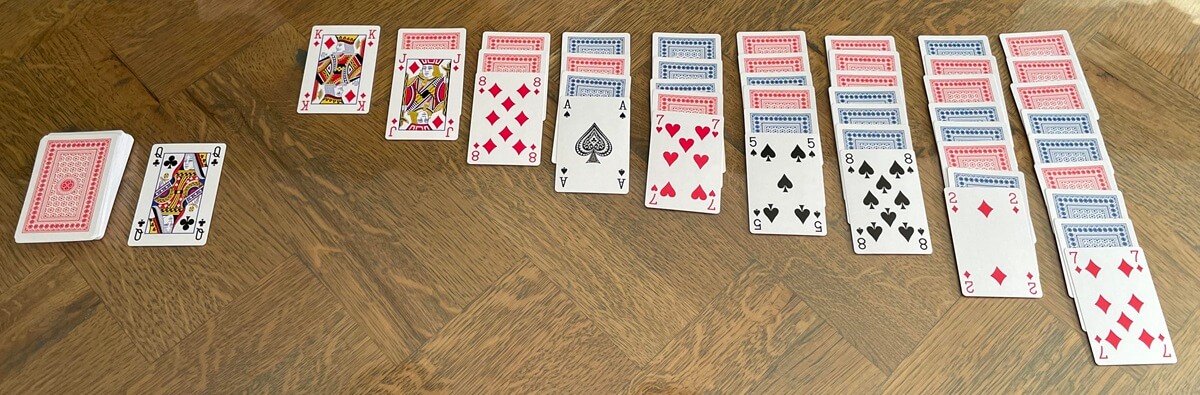
- Place a pile of 9 cards face down and turn the top card face up.
- To the left of this pile, place a pile of 8 cards and turn the top card face up.
- Continue this pattern, each time reducing the pile by one card, until the final pile has only 1 face-up card.
- You now have 9 tableau piles in total.
The remaining 59 cards form the stock pile, placed face down. See the example image below for a sample layout.
Gameplay
Just like in classic klondike solitaire, your goal is to build up the foundation piles from Ace to King for all suits.
- Above the 9 tableau piles, there are 8 empty foundation piles at the start of the game.
- These foundation piles must be built up in suit, from Ace to King. By the end of the game, you’ll have two complete sets of Hearts, Diamonds, Clubs, and Spades.
- Within the tableau, you may move a face-up card onto another face-up card of the opposite color and one rank higher (for example, a red 9 on a black 10). You can then place a black 8 on the red 9, and so on. When a facedown card becomes the top card of a pile, you may turn it face up. Remember that Aces are low, so Kings cannot be placed on Aces.
- You may also move a sequence of face-up cards or part of a sequence. For example, a sequence Jack-10-9-8-7-6 can be moved onto a Queen of the opposite color, or a partial sequence such as 9-8-7-6 can be placed on a 10 of the opposite color.
- If a tableau pile becomes empty, you may fill the space with a King or a sequence starting with a King.
- You may move an Ace to a foundation pile as soon as it becomes available. Each foundation pile is then built up in sequence and suit, for instance, on the Ace of Hearts you place the 2 of Hearts, then the 3 of Hearts, and so on.
- When you can no longer move any cards, draw from the stock pile. Depending on the variant you play, you may turn over one or three cards at a time. If you turn three cards at once, only the top card can be played; once it’s used, the next card becomes available. The variants are knowns as double klondike solitaire turn 1 and double klondike solitaire turn 3.
- When you’ve gone through the stock, you can reshuffle the unused cards and form a new stock pile to continue playing.
- The game ends successfully when all foundation piles are complete from Ace to King. It’s also possible to reach a point where no further moves are possible.
Double klondike for 2 players
Sometimes the term double klondike is also used for a two-player version of double klondike, where players compete against each other. That variant is not a solitaire game. However, the name most often refers to the solo version described above, played with two decks of cards. If you enjoy double klondike and want to try playing against others, give kings in the corner a try!
Learn more about solitaire card games
Do you want to learn more about solitaire card games? Please view our list of solitaire card games.