



Whist card game rules
Whist is a classic English card game for four players. In the 18th century, it was the most popular card game in the Western world. You play in two fixed teams and try to win as many tricks as possible with your partner. The rules of whist are fairly simple: there is no bidding round, and the last card dealt determines the trump suit. Even so, the game offers plenty of room for tactics and teamwork.
On this page, we explain how to play whist using the rules of the classic version. Other card games also have whist in their name, such as solo whist and bid whist. These versions have different rules and often include a bidding round.

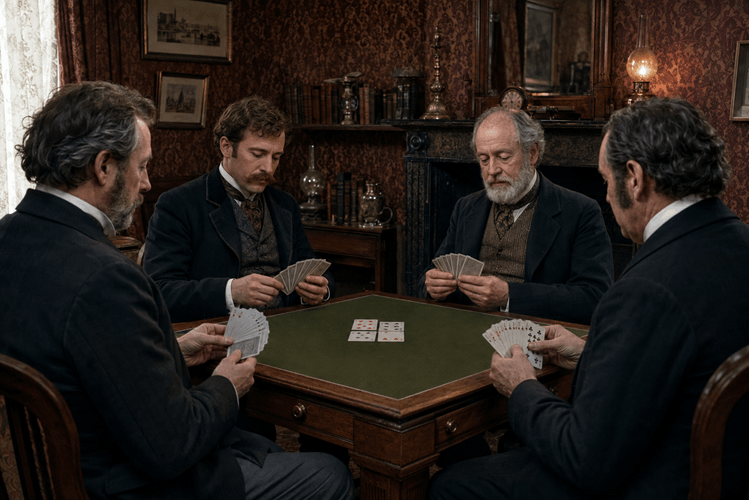
General rules of the game
- Whist is played by four players in two fixed teams.
- Players on the same team sit opposite each other.
- The game uses all 52 cards in a standard deck, without jokers.
- The ace is the highest card and the 2 is the lowest. The order is ace, king, queen, jack, 10, 9, 8, 7, 6, 5, 4, 3 and 2.
- Each player receives 13 cards.
- Play moves clockwise.
- The last card dealt determines the trump suit for the hand.
- Players must follow suit if possible.
- The highest trump card wins the trick. If no trump is played, the highest card of the suit led wins.
- A team scores one point for every trick it wins beyond the first six.
Players and teams
The four players form two teams of two. Your partner sits directly opposite you. The teams stay the same throughout the game.
You may not discuss the cards in your hand with your partner. Instead, teamwork means paying close attention to the cards played and understanding your partner’s choices.
Dealing the cards in whist
The player to the dealer’s left shuffles the cards. The player to the dealer’s right then cuts the deck. The dealer deals the cards face down, one at a time, clockwise, starting with the player on the left. This continues until all the cards have been dealt and each player has 13 cards.
The very last card belongs to the dealer, who places it face up on the table. Its suit becomes the trump suit for that hand. For example, if the last card is a diamond, all diamonds are trumps for that hand.
The face up trump card stays in front of the dealer until it is their turn to play to the first trick. The dealer then picks it up and plays a card according to the normal rules. After each hand, the deal passes clockwise to the next player.
How to play whist
The player to the dealer’s left leads to the first trick and may play any card. The other players then each play one card in clockwise order. Once all four players have played a card, the trick is complete.
The following rules apply during play:
- If you have a card of the suit led, you must play a card of that suit. This is called following suit.
- If you cannot follow suit, you may play any other card. You may play a trump, but you do not have to.
- If one or more trumps have been played, the highest trump wins the trick.
- If no trump has been played, the highest card of the suit led wins.
- A card of a different suit cannot win the trick unless it is a trump.
- The winner of the trick leads to the next trick.
Keep track of the tricks won by each team. Under the traditional rules, a player may look at the cards from the previous trick as long as the next trick has not started.
Example of a trick
Hearts are trumps, and the first player leads the 10 of spades. The next players play the king of spades, the 3 of spades and the 2 of hearts. Although the king of spades is the highest card of the suit led, the 2 of hearts wins the trick because hearts are trumps.
If the last player had played the ace of clubs instead, the king of spades would have won. A club cannot win a trick led with spades when clubs are not trumps.
Scoring in whist
Each hand consists of 13 tricks. A team’s first six tricks do not score any points. Each trick beyond the first six is worth one point. These additional tricks are called odd tricks.
| Tricks won | Points |
| 7 tricks | 1 point |
| 8 tricks | 2 points |
| 9 tricks | 3 points |
| 10 tricks | 4 points |
| 11 tricks | 5 points |
| 12 tricks | 6 points |
| 13 tricks | 7 points |
The first team to reach 5 points wins the game. This usually takes several hands. You can also agree beforehand to play to 7 or 10 points, or to play a fixed number of hands.
Scoring with honours
Under the traditional rules, extra points can be scored for holding the highest trumps. These cards are called honours: the ace, king, queen and jack of the trump suit.
| Honours held by one team | Extra points |
| 3 of the 4 honours | 2 points |
| All 4 honours | 4 points |
These points are based on the honours the two partners held between them after the deal, not the honours they win in tricks. A team that already has 4 points cannot score the fifth and winning point through honours. If both teams would score enough points to win in the same hand, points for tricks are counted first.
Many players leave out honours today because they depend mainly on the cards dealt and add more luck to the game. Before you start, agree whether you will play with or without honours.
Other ways to determine the trump suit
In classic whist, the last card dealt determines the trump suit. You can also rotate the trump suits in a fixed order. A common order is hearts, diamonds, spades and clubs. The sequence then starts again with hearts.
Some competitions include a hand without trumps after the four trump suits. In a hand without trumps, the highest card of the suit led always wins the trick.
Tips for playing whist
- Try leading from a strong, long suit. This improves your team’s chances of winning several tricks in that suit.
- Remember which high cards and trumps have already been played.
- Watch for players who cannot follow suit. You then know they have no cards left in that suit and may be able to trump it later.
- Play as a team. The cards your partner plays can give you information about their strong and weak suits.
- Use your trumps carefully. A low trump can be useful later for beating a high card of another suit.
Whist today
As we mentioned in the introduction, whist was the most popular card game in the Western world in the 18th century. In the 20th century, it was overtaken by bridge, which can be seen as a successor to whist. However, the classic whist card game is still played in English speaking countries today.
Several descendants and variants of whist are still played today. Spades and bid whist are particularly popular in the United States, while solo whist is still played in Britain. Whist also gave rise to regional games in the Netherlands and Belgium that remain popular today. These include rikken, mainly played in the southern Netherlands, and the Belgian variants wiezen and kleurenwiezen, which are still among the most popular card games in Flanders.
Learn more about card games
Do you want to learn more about card games? Please visit our knowledge center with articles about all kinds of card games.