



Court Piece Rules How to Play Rung and Rang
Court Piece is a partnership card game widely played in India and Pakistan, where it is also known as Rung, Rang or Coat Piece. Four players form two teams, with partners sitting opposite each other. Your aim is to win at least seven tricks together. The twist is that the trump suit is chosen after just the first five cards have been dealt.
Learn how to play Court Piece with the basic rules below, followed by variations including Double Sir, Hidden Rung and Be-ranga. Rules and scoring differ between regions and playing groups, so agree on your version before you start.
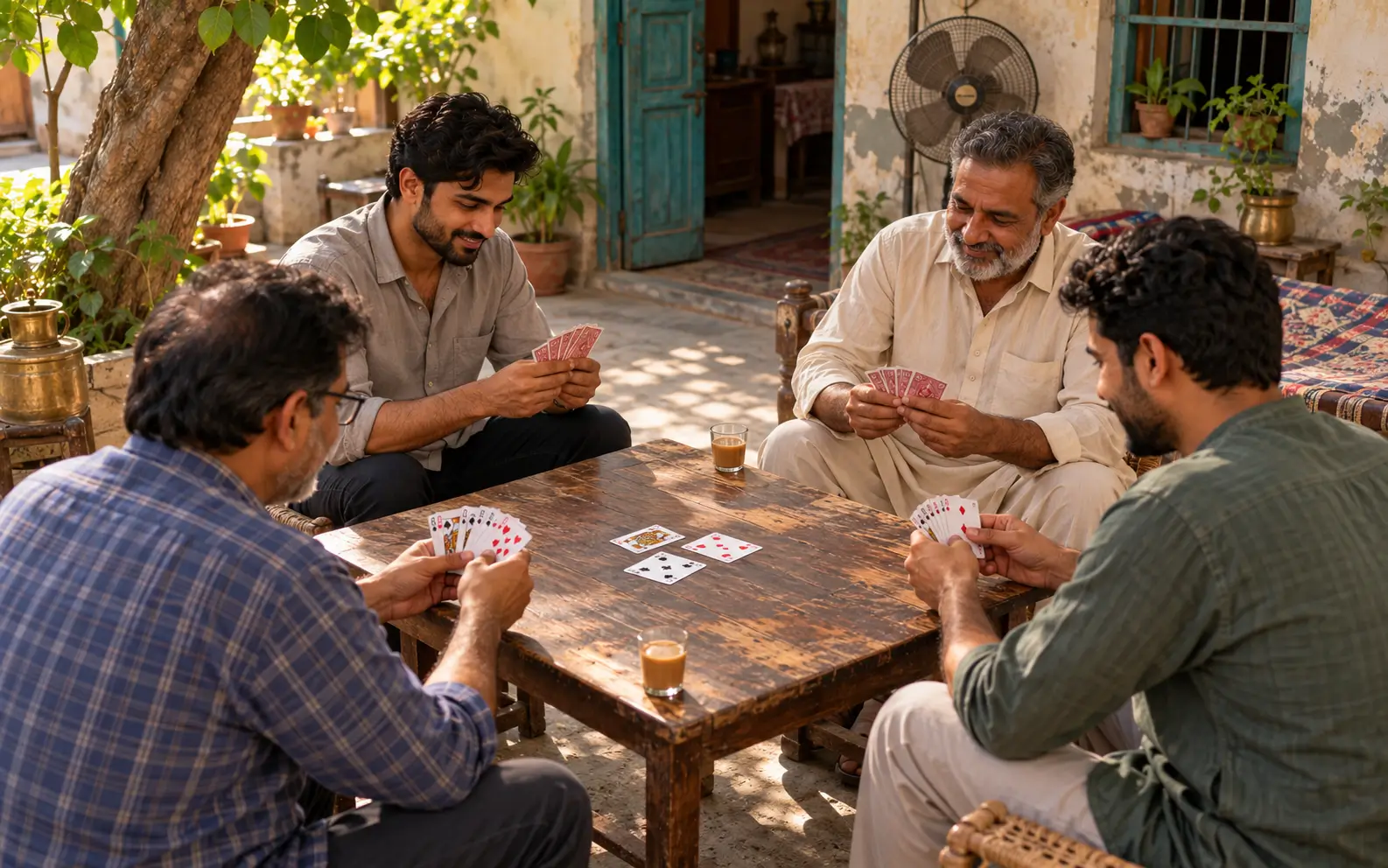
Court Piece card game rules
- Court Piece is played by four players in two fixed partnerships. Partners sit opposite each other.
- Use a standard 52-card deck without jokers. Each player receives 13 cards.
- Cards rank from highest to lowest: ace, king, queen, jack, 10, 9, 8, 7, 6, 5, 4, 3, 2.
- Your team aims to win at least seven tricks. A trick consists of one card played by each player.
- The player to the dealer’s right, called the caller, chooses trumps and leads to the first trick.
- Deal and play move anticlockwise, to the right.
- You must follow suit if you can: play a card of the same suit as the first card in the trick.
- If you cannot follow suit, you may play any card. You do not have to play a trump.
- The highest card of the suit led wins the trick, unless a trump is played. If any trumps are played, the highest trump wins.
- The winner of each trick leads to the next one.
How to deal in Court Piece
Choose a dealer at random for the first hand.
- The dealer shuffles, and the player to the dealer’s right may cut the deck.
- Deal five cards to each player.
- The caller looks only at these five cards and announces the trump suit.
- Deal four more cards to each player, followed by another four.
- Everyone now has 13 cards, and the caller leads to the first trick.
The deal follows a 5–4–4 pattern. The caller must choose trumps before seeing the remaining eight cards in their hand.
Choosing the trump suit
The caller chooses hearts, diamonds, clubs or spades. That suit outranks the other three suits for the entire hand. Cards within the trump suit keep their normal ranking.
For example, suppose clubs are trumps and another player leads the ace of hearts. If you have no hearts, you can beat it with the two of clubs. A higher club played later would beat your two. If you have a heart, however, you must follow suit.
There is no bidding round. The caller simply names the trump suit.
Winning a hand and scoring a court
The following results apply to the basic game, also called Single Sir or Single Sar.
| Result | Explanation |
|---|---|
| Ordinary win | Your team wins seven tricks, while your opponents win at least one. |
| Court or kot | Your team wins the first seven tricks without conceding any. |
| Goon court | The dealer’s team wins the first seven tricks against the team that chose trumps. |
| Seven hands in a row | In traditional scoring, winning seven consecutive hands also earns a court. |
A hand normally ends as soon as one team has won seven tricks.
Court Piece scoring
Individual cards have no point value. The result of the hand determines the score, and several scoring systems are used.
For a straightforward points game, you can use this system:
| Result | Points for the winning team |
|---|---|
| Ordinary win by the caller’s team | 1 |
| Ordinary win by the dealer’s team | 2 |
| Court by the caller’s team | 3 |
| Goon court by the dealer’s team | 4 |
The points shown are the total for that hand. A court by the caller’s team therefore scores three points, rather than one plus three. You could play to an agreed target of ten points.
In traditional court scoring, an ordinary hand win only counts towards a run of seven consecutive wins. A team scores a court by winning the first seven tricks of a hand or by winning seven hands in a row. The run starts again after a court. Agree on your scoring system before play begins.
Who deals the next hand
The losing team provides the next dealer:
| Result | Next dealer |
|---|---|
| The dealer’s team wins | The player to the previous dealer’s right |
| The caller’s team wins without a court | The same dealer |
| The caller’s team scores a court | The previous dealer’s partner |
This allows the winning team to choose trumps in the next hand.
Court Piece variations and Rung rules
Single Sir and Single Sar
In Single Sir, each trick is collected immediately by the team that wins it. Seven tricks win the hand; winning the first seven tricks earns a court.
Some groups only call it a court if a team wins all 13 tricks. Agree beforehand whether you are using the seven-trick or 13-trick rule.
Double Sir and Double Sar
In Double Sir, tricks are not collected as soon as they are won. Instead, they are placed face down in a shared pile in the middle of the table.
- A team only collects the pile when the same player wins two consecutive tricks.
- Two consecutive tricks won by different partners do not qualify.
- Once the pile has been collected, a new pile begins. If the same player wins a third trick in a row, that trick stays in the middle; they need another consecutive win to collect again.
- The winner of the 13th trick collects any tricks left in the middle.
For example, four tricks are already in the middle. You win the fifth and sixth tricks, so you collect all six for your team, including any earlier tricks won by your opponents.
Only collected tricks count towards your team’s total. Collect at least seven to win the hand. To score a court within a single hand, your team must collect all 13. If your opponents have not collected any tricks yet, continue playing to establish whether you achieve a court.
Hidden Rung and Hidden Rang
In Hidden Rung, the trump suit is kept secret at first. The caller sets aside one of their first five cards face down. Its suit determines trumps, and the card cannot be played until it has been revealed.
- Until the card is revealed, no suit acts as trumps.
- A player who cannot follow suit may ask for the trump card to be revealed.
- The player who asks must then play a trump if they can.
- The caller may also reveal the card when leading to a trick, but must then lead a trump.
- The revealed card returns to the caller’s hand.
Trumps take effect from the moment the card is revealed. A card of that suit played earlier in the trick does not become a trump retrospectively. If that suit was led, the highest card of the suit led still determines the winner unless beaten by a trump played after the reveal.
You can play Hidden Rung using Single Sir rules, where each trick counts immediately and seven tricks win the hand. A Double Sir version with a shared pile is also played. Agree on which combination you are using.
Be-ranga and choosing trumps during play
In Be-ranga, nobody chooses trumps before play. Deal 13 cards to each player, and the player to the dealer’s right leads to the first trick.
The first player who cannot follow suit plays a card of another suit. That suit immediately becomes trumps, including for the trick currently being played.
For example, spades are led. You have no spades and play the eight of diamonds. Diamonds become trumps, so your card beats the spades unless someone plays a higher diamond later in the trick.
There are two forms:
| Variation | How tricks are collected |
|---|---|
| Be-ranga with Single Sir | Each trick counts immediately; seven tricks win the hand. |
| Be-ranga Double Sar | Tricks stay in the middle until the same player wins two consecutive tricks. |
In Be-ranga Double Sar, the earliest opportunity to collect the pile is on the trick after trumps are established. If the same player wins both the trick that establishes trumps and the next trick, they may collect the pile. The winner of the final trick collects anything left in the middle.
Optional house rules
Some groups use additional rules:
- Redeal: the caller may request a new hand if all five of their initial cards rank below a jack.
- Trumps chosen by a later card: agree that a particular card determines trumps, such as the caller’s seventh, tenth or 13th card.
- Consecutive aces in Double Sir: winning two consecutive tricks with aces does not allow you to collect the pile.
- Restricted collection in Double Sir: the pile cannot be collected after certain tricks, such as the second or 12th.
These rules only apply if everyone agrees to them before play.
A brief history of Court Piece
Court Piece is part of South Asia’s card-playing traditions and is widely played in India and Pakistan. The names Rung, Rang, Coat Piece and Court Piece generally refer to the same basic game.
The game is passed down through families and groups of friends. This has led to different scoring systems, definitions of a court and rules for choosing trumps. The name Rung or Rang alone does not tell you which variation someone plays.
Related card games
Court Piece shares many features with Troefcall, played in the Netherlands and Suriname. Both use two partnerships and a trump choice based on five cards, although their scoring and additional rules differ.
The Iranian game Hokm is closely related too. Court Piece also belongs to the Whist family of games, which centre on winning tricks, following suit and working with a fixed partner.
Explore more card game rules
Visit our knowledge centre for more card game rules and guides.